
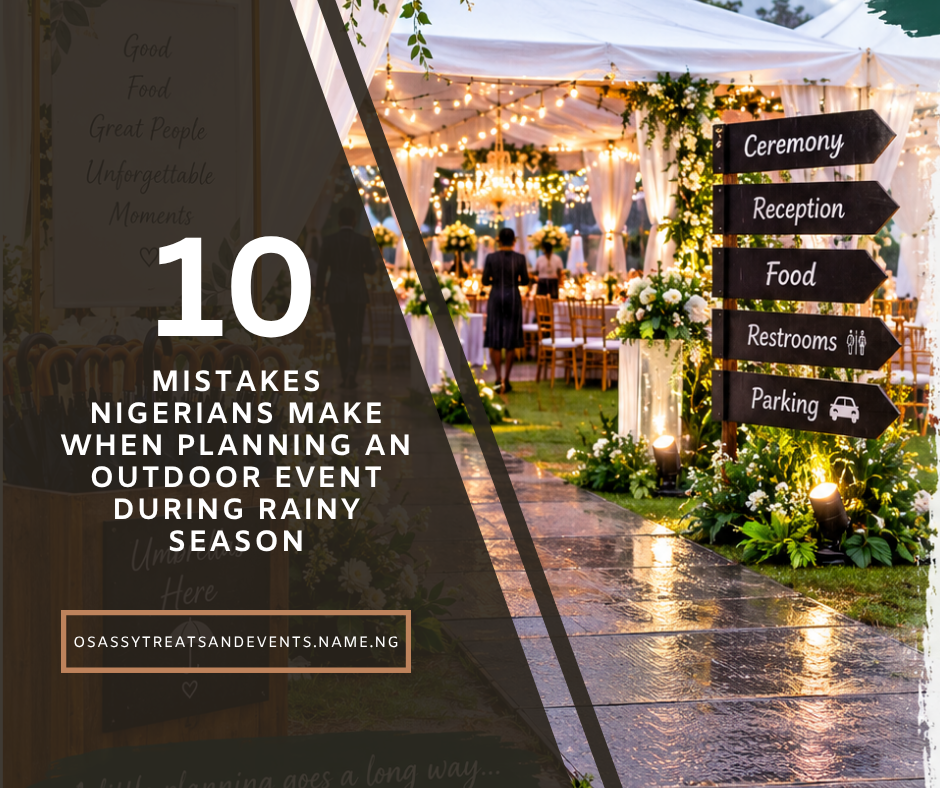
Planning an outdoor event in Nigeria can be beautiful.
A garden wedding, birthday party, traditional ceremony, corporate picnic, graduation celebration or outdoor reception can have an atmosphere that an indoor hall simply cannot replicate.
Then the clouds gather.
And suddenly the biggest question isn’t:
“Will the décor look beautiful?”
It’s:
“Where will everybody sit if it starts raining?”
Rain should not automatically ruin an outdoor event. But it does require a different level of planning.
Nigeria’s 2026 weather outlook has highlighted variable rainfall patterns, with rainfall expected to be normal to above normal in many areas and the season potentially lasting longer than normal. NiMet has also continued issuing heavy-rainfall and flash-flood advisories during the year.
NEMA has similarly urged Nigerians to pay attention to official warnings, prepare for flooding and avoid flood-prone areas when risks increase.
So if you’re planning an outdoor event during the rainy season, don’t simply hope for sunshine.
Plan for rain.
Here are 10 common mistakes to avoid.
1. Choosing a Beautiful Venue Without Checking Its Drainage
This is one of the biggest mistakes.
A venue may look perfect during a dry-weather inspection but become completely different after heavy rainfall.
Before paying a deposit, visit the location during or shortly after rainfall if possible.
Look at:
- Where water collects
- How quickly the compound drains
- Whether the entrance floods
- The condition of access roads
- Parking areas
- Toilets
- Kitchen/service areas
- Guest walkways
- Emergency exits
- Nearby drainage channels
Don’t only ask:
“Is this venue suitable for an outdoor event?”
Ask:
“What happens here when it rains heavily?”
That’s a much more important question.
NEMA has repeatedly identified blocked drainage, poor drainage infrastructure and low-lying or vulnerable locations as factors that can increase flood risk.
2. Assuming a Tent Automatically Solves the Rain Problem
A tent is helpful.
But a tent is not a complete rainy-season strategy.
Some event planners hire a tent and assume everything is covered.
But rain can still enter from:
- Open sides
- Wind-driven rain
- Poorly positioned gutters
- Gaps between tent sections
- Ground-level runoff
- Water pooling underneath the tent
When hiring a tent, ask the supplier:
- Is it waterproof?
- Are sidewalls available?
- Are sidewalls included?
- Can the tent withstand strong winds?
- How is rainwater directed away?
- Is the flooring elevated?
- What happens if additional sidewalls are needed?
- Who is responsible for emergency adjustments?
A professional supplier should be able to explain the rain plan clearly.
3. Ignoring the Ground
Your guests aren’t only worried about getting wet.
They’re worried about walking through mud in expensive clothes and shoes.
A beautiful outdoor venue can quickly become uncomfortable if guests have to walk through:
- Mud
- Wet grass
- Puddles
- Slippery surfaces
- Uneven ground
This is especially important for Nigerian weddings and traditional ceremonies where guests may be wearing elaborate outfits and formal shoes.
Consider providing:
- Temporary flooring
- Walkway mats
- Wooden platforms
- Carpeted pathways
- Covered walkways
- Non-slip surfaces around high-traffic areas
Don’t wait until the morning of the event to discover that the main entrance has become a mud path.
4. Planning the Event Without a Rain Backup
This is the biggest mistake of all.
Every outdoor rainy-season event should have a Plan B.
And Plan B should be more specific than:
“We’ll figure something out if it rains.”
Ask:
Where exactly will the guests go?
Will you:
- Move inside?
- Expand the tent?
- Move the ceremony under cover?
- Relocate the buffet?
- Move the DJ?
- Protect the cake?
- Relocate the photo booth?
- Move the children’s area?
- Change the seating arrangement?
Your backup plan should be physically possible.
If the venue cannot accommodate everyone indoors, don’t call the indoor room your backup plan.
5. Checking the Weather Only on the Morning of the Event
Weather planning should start before the event day.
NiMet provides seasonal forecasts, weather outlooks, heavy-rainfall bulletins and flash-flood information that can help event planners make informed decisions.
Instead of checking only one weather app on the morning of the event, establish a monitoring routine.
For example:
7 days before:
Check the broader forecast.
3 days before:
Review the forecast and discuss contingencies with vendors.
24 hours before:
Confirm the latest rainfall outlook.
Event morning:
Check current conditions and official warnings.
During the event:
Assign someone to monitor weather developments.
Weather forecasts are not guarantees, but they are valuable planning information.
6. Forgetting About Lightning and Strong Winds
Rain isn’t the only concern.
Thunderstorms can also bring:
- Lightning
- Strong winds
- Flying debris
- Power interruptions
- Dangerous conditions around temporary structures
If severe weather approaches, don’t keep guests outdoors simply because the rain hasn’t started yet.
Your event planner, venue management and technical team should have a clear process for suspending outdoor activities and moving people to safer areas.
NEMA advises people to take early action when flood or severe-weather risks are present rather than waiting until conditions become dangerous.
Pay particular attention to:
- Tents
- Temporary stages
- Truss structures
- Lighting equipment
- Electrical cables
- Generators
- Decorative installations
- Large umbrellas
- Signage
Safety should always take priority over keeping the programme on schedule.
7. Leaving Electrical Equipment Exposed
This is one area where you should never improvise.
Outdoor events often involve:
- Speakers
- DJ equipment
- Lighting
- Extension cables
- Generators
- Refrigerators
- Food warmers
- Photobooths
- Charging stations
Rain and electricity are a dangerous combination.
Electrical equipment should be properly protected and installed by qualified personnel.
Cables should be managed so they don’t sit in standing water or create trip hazards.
NEMA’s flood-safety guidance warns against touching electrical equipment while wet or standing in water.
If water reaches electrical equipment, don’t try to solve the problem yourself.
Have the appropriate technical or electrical professional handle it.
8. Scheduling the Most Important Moments at the Worst Time
Your programme matters.
If you’re planning an outdoor wedding, for example, you may have:
- Couple’s entrance
- Ceremony
- Photos
- First dance
- Cake cutting
- Toasts
- Outdoor entertainment
- Food service
Don’t automatically assume everything should happen outdoors.
Build flexibility into the schedule.
For example:
If the weather is good
Proceed with:
- Outdoor ceremony
- Outdoor photos
- Cocktail hour
If rain approaches
Move:
- Guest seating
- Cake
- Food
- Sound equipment
- Important décor
under cover before the rain arrives.
A little flexibility can save a lot of stress.
9. Choosing the Wrong Food and Cake Setup
Rainy weather can affect catering too.
Food needs to be protected from:
- Rain
- Mud
- Excess moisture
- Wind
- Insects
- Temperature fluctuations
Don’t position the buffet directly at the edge of an open tent.
The same applies to your wedding cake.
A delicate buttercream or fondant cake shouldn’t be left exposed to rain, heat and humidity.
Your caterer and baker should know the venue conditions before finalising the setup.
Ask your caterer:
- Where will food be prepared?
- Where will it be stored?
- Is the buffet fully covered?
- How will food be transported?
- Where will serving staff stand?
- Is there a dry backup area?
10. Forgetting the Guest Experience
Sometimes event planners focus so heavily on protecting the décor that they forget about the people.
Imagine arriving at an outdoor event during heavy rain and discovering:
- No covered entrance
- No dry walkway
- No place to leave umbrellas
- Wet chairs
- Muddy floors
- Poor lighting
- No clear instructions
- Long queues outside
Even if the decorations are beautiful, guests will remember the discomfort.
Make the rainy-season guest experience intentional.
Consider:
Covered entrance
Give guests a protected route from their cars to the venue.
Umbrella station
Provide a place where guests can leave wet umbrellas.
Towels or tissues
Useful for wiping wet seats, hands or shoes.
Covered seating
Make sure guests don’t have to move chairs every time the rain starts.
Dry toilets
Keep toilets accessible and protected from water.
Clear signage
Guests should know where to go if the weather changes.
Bonus Mistake: Thinking “God Will Provide the Weather”
Faith is important to many Nigerians.
But good event planning still requires preparation.
You can hope for good weather and have a rain plan.
Those two things are not contradictory.
The professional approach is:
Pray for good weather. Plan for bad weather.
How to Create a Proper Rain Plan
Don’t just write “rain plan” in your event notebook.
Create an actual system.
Step 1: Identify the risk
Ask:
- Is the venue flood-prone?
- Is the ground low-lying?
- Is there adequate drainage?
- Is the road accessible during rain?
- Is the event completely outdoors?
- Is there indoor capacity?
Step 2: Identify your backup location
Decide where each part of the event moves.
| Event Element | Normal Location | Rain Backup |
|---|---|---|
| Ceremony | Garden | Covered hall/tent |
| Guest seating | Outdoor | Tent |
| Buffet | Outdoor | Covered service area |
| Cake | Cake table | Indoor/dry area |
| DJ | Stage | Protected stage |
| Photos | Garden | Covered photo area |
| Children | Outdoor | Indoor activity area |
Step 3: Assign responsibility
Someone needs to make the call.
It could be:
- Event planner
- Venue manager
- Couple
- Safety lead
Don’t have five different people making conflicting decisions.
Step 4: Tell vendors
Your caterer, decorator, DJ, photographer, videographer and other vendors should know the rain plan.
Step 5: Tell key staff
Servers, ushers and security should know where guests should go if conditions change.
What to Put in Your Rainy-Season Emergency Kit
Your planner should consider having:
☐ Umbrellas
☐ Waterproof storage boxes
☐ Towels
☐ Cleaning cloths
☐ Floor mats
☐ Non-slip mats
☐ Plastic covers
☐ Extension protection
☐ Emergency lighting
☐ Torch/flashlight
☐ First-aid supplies
☐ Extra signage
☐ Garbage bags
☐ Cable covers
☐ Backup power arrangements
☐ Drinking water
☐ Communication plan
The exact contents should depend on the venue and event type.
How to Protect Your Event Décor
Rain can damage more than just the seating area.
Think about:
Flowers
Fresh flowers may need protection from wind and heavy rain.
Fabric
Drapes, tablecloths and backdrops can become wet, dirty or difficult to manage.
Paper products
Menus, programmes, seating charts and signage should be protected.
Electronics
Lighting and audio equipment require special attention.
Furniture
Outdoor furniture should be suitable for the conditions or have a dry storage plan.
Gifts
Gift tables should never be placed somewhere that can easily become exposed to rain.
Don’t Forget the Parking Area
An outdoor event can have a perfect venue and still become a nightmare because of the parking area.
Check:
- Road access
- Parking surface
- Drainage
- Mud
- Flooding
- Lighting
- Distance from parking to venue
If guests have to walk 200 metres through wet grass and mud to reach the reception, your venue experience has already suffered.
Where appropriate, consider:
- Covered drop-off points
- Ushers
- Temporary walkways
- Valet arrangements
- Alternative parking
- Golf carts or shuttle support for large venues
Rainy-Season Catering Tips
If you’re serving food outdoors, remember:
Keep food covered
Protect food from rain, insects and environmental contamination.
Keep the service area dry
Servers need enough space to work safely.
Protect drinks
Bottled drinks are easier to manage than open beverage containers during unpredictable weather.
Protect the cake
Have a dry, temperature-controlled backup location where possible.
Don’t leave food outside unnecessarily
If the weather deteriorates, move food to a protected area promptly.
Should You Cancel an Outdoor Event Because of Rain?
Not necessarily.
Light rain may be manageable with adequate shelter.
But severe weather, flooding, lightning or unsafe access conditions require a different response.
NEMA’s guidance is clear that people should heed official warnings, move to safer or higher ground when flooding threatens and avoid walking or driving through floodwater.
The decision should therefore be based on actual safety conditions, not simply whether guests might get slightly wet.
If the venue becomes unsafe, the event schedule should not take priority over people’s safety.
The Ultimate Rainy-Season Event Checklist
Before the event:
☐ Check the venue’s drainage
☐ Visit after rainfall if possible
☐ Confirm tent specifications
☐ Arrange sidewalls
☐ Plan temporary flooring
☐ Identify an indoor backup
☐ Check parking access
☐ Monitor official forecasts
☐ Discuss rain plans with vendors
☐ Protect electrical equipment
☐ Plan for lightning and strong winds
☐ Protect catering areas
☐ Protect the wedding cake
☐ Prepare umbrellas
☐ Assign a weather decision-maker
☐ Tell ushers what to do
☐ Have emergency contacts available
On the event day:
☐ Monitor weather updates
☐ Keep walkways clear
☐ Check tent stability
☐ Keep electrical areas dry
☐ Check drainage
☐ Protect food
☐ Protect décor
☐ Keep guests informed
☐ Be prepared to relocate activities
Final Thoughts
Rain doesn’t have to ruin a Nigerian outdoor event.
Poor planning does.
The secret is not trying to control the weather. You can’t.
The secret is designing your event so that rain doesn’t have the power to completely control your event.
Choose the venue carefully.
Check drainage.
Have a genuine Plan B.
Protect your guests.
Protect your food.
Protect your equipment.
Monitor official weather information.
And most importantly, know when weather conditions have become unsafe.
A beautiful event is important.
But a safe, comfortable and well-organised event is what makes guests remember the occasion for the right reasons.
Frequently Asked Questions
Can I hold an outdoor wedding during Nigeria’s rainy season?
Yes, but the venue and contingency plan matter enormously. Consider proper shelter, drainage, access roads, flooring and an alternative location before confirming the event.
Should I rent a tent for an outdoor rainy-season event?
A suitable waterproof tent with properly installed sidewalls can provide important protection, but it should be part of a wider weather plan rather than your only precaution.
How early should I check the weather?
Start monitoring several days before the event and continue checking official updates closer to the event. NiMet publishes weather forecasts, heavy-rainfall bulletins and flash-flood information that can help with planning.
What should I do if the venue starts flooding?
Prioritise people’s safety. Follow official warnings and move guests to a safe location or higher ground where necessary. Do not encourage guests or staff to walk or drive through floodwater.
How can I protect my event cake during rainy weather?
Keep the cake in a dry, temperature-controlled location until it is time to display it. Coordinate delivery and setup with the baker and venue so the cake isn’t exposed unnecessarily.
What is the biggest rainy-season event mistake?
Not having a realistic Plan B. A rain plan should identify exactly where guests, food, entertainment, equipment and décor will go if outdoor conditions become unsuitable.
SEO Details
SEO Title:
10 Mistakes Nigerians Make When Planning an Outdoor Event During Rainy Season
Meta Description:
Planning an outdoor Nigerian event during rainy season? Avoid these 10 common mistakes involving tents, flooding, drainage, food, electricity, guests and weather planning.
Primary Keyword:
outdoor event during rainy season in Nigeria
Secondary Keywords:
- rainy season event planning Nigeria
- outdoor wedding Nigeria rainy season
- Nigerian outdoor event ideas
- rainy season wedding planning
- outdoor event rain plan
- wedding rain plan Nigeria
- Nigerian event planning tips
- outdoor party during rainy season
- event planning Nigeria
- rainy season wedding mistakes
Suggested URL Slug:/outdoor-event-rainy-season-nigeria-mistakes