
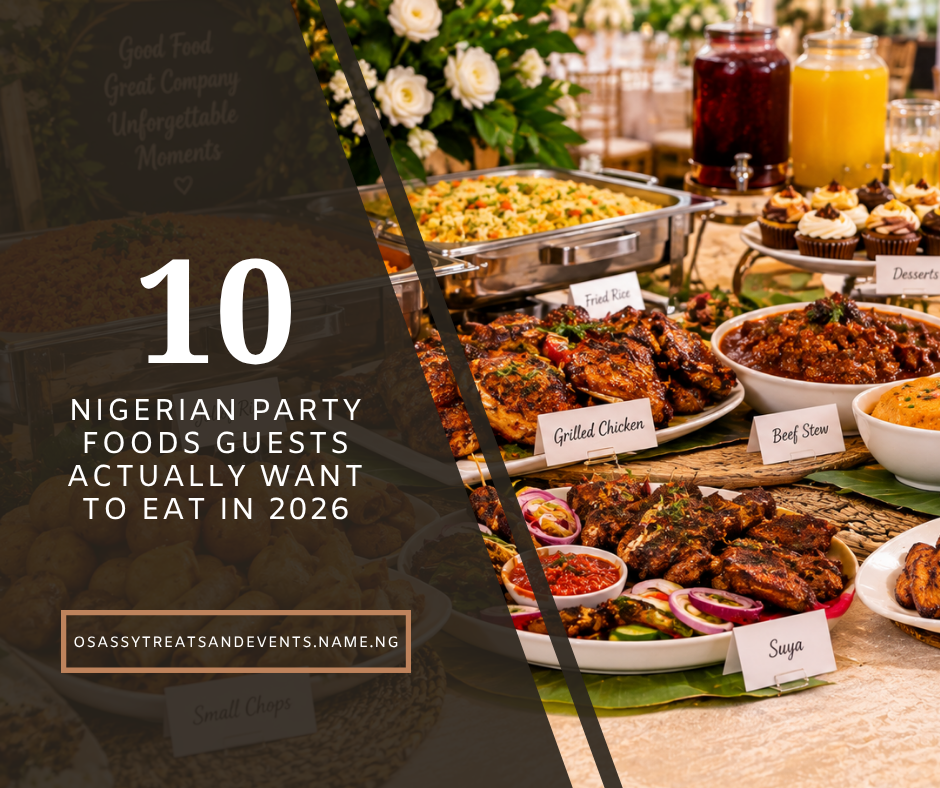
10 Nigerian Party Foods Guests Actually Want to Eat in 2026
If there is one thing Nigerians take seriously at a party, it is food.
You can have beautiful décor, an amazing DJ, an impressive venue and a perfectly coordinated event—but if the food disappoints, your guests will remember.
The good news is that planning a great Nigerian party menu doesn’t necessarily mean serving twenty different dishes.
The secret is choosing familiar foods people love, adding enough variety for different tastes, and serving everything at the right time.
From classic party jollof to small chops, grilled meats and refreshing Nigerian drinks, here are 10 party foods that can make your next Nigerian celebration memorable.
1. Party Jollof Rice
Let’s start with the obvious.
Party jollof is a Nigerian event classic for a reason.
Whether it’s a wedding, birthday, naming ceremony, graduation party, anniversary or corporate celebration, jollof rice remains one of the safest choices for feeding a crowd.
But not all jollof is created equal.
Guests often have strong opinions about what makes good party jollof:
- The rice must be well-seasoned.
- It shouldn’t be too dry.
- It shouldn’t be excessively oily.
- The grains shouldn’t be completely mushy.
- The pepper and tomato flavour should be balanced.
- And for many guests, that smoky “party” flavour is part of the experience.
How to make jollof more exciting
You can pair it with:
- Fried chicken
- Grilled chicken
- Beef
- Turkey
- Fried plantain
- Coleslaw
- Moi moi
- Salad
If you’re catering for a large crowd, taste-testing the caterer’s jollof before the event is one of the smartest things you can do.
After all, you don’t want to discover on the wedding day that the couple and the caterer have very different definitions of “perfect jollof.”
2. Small Chops
If jollof is the main attraction, small chops are often the opening act.
Puff-puff, spring rolls, samosas and other bite-sized snacks are popular at Nigerian celebrations because guests can eat them while mingling, taking photographs and waiting for the main meal.
A typical small-chops selection might include:
- Puff-puff
- Spring rolls
- Samosas
- Mosa
- Fish rolls
- Mini meat pies
- Chicken
- Gizzard
- Plantain
- Asun
The exact combination depends on the event and budget.
Recent Nigerian catering coverage continues to place small chops among the standard offerings for weddings, birthdays, office events and other celebrations.
The secret to good small chops?
Variety and freshness.
You don’t necessarily need ten different items.
A well-made selection of four or five items can be more enjoyable than a large box filled with mediocre snacks.
3. Suya
Few foods create the kind of excitement that suya does.
The smell alone can attract guests.
Suya works particularly well for evening parties, outdoor celebrations and weddings because it can be served as a snack, appetiser or late-night food.
Serve it with:
- Sliced onions
- Tomatoes
- Cabbage
- Cucumber
- Yaji spice
- Fresh pepper
For a more modern event, consider creating a live suya station where guests can watch the meat being prepared and served fresh.
This also gives guests something to interact with rather than simply walking up to a buffet.
Interactive food stations are increasingly being incorporated into Nigerian celebrations as part of the overall guest experience.
4. Peppered Chicken or Grilled Chicken
Chicken is one of the easiest proteins to incorporate into a Nigerian event menu.
You can serve it:
- Fried
- Grilled
- Peppered
- Barbecued
- As chicken wings
- As drumsticks
- In small portions alongside rice
For large events, consistency is important.
Nobody wants to receive a beautifully seasoned piece of chicken while the person at the next table gets a piece that is half the size.
Catering tip
Decide on your portion size before the event.
If you’re serving 300 guests, establish exactly how many pieces of chicken each guest should receive and prepare an appropriate spare quantity.
This makes portion control easier and reduces the chance of food running out unexpectedly.
5. Fried Rice
Some guests are loyal to jollof.
Others are firmly on Team Fried Rice.
Why not serve both?
Fried rice gives guests an alternative and works particularly well when paired with chicken, turkey, grilled meats and plantain.
A typical event fried rice may contain:
- Carrots
- Green beans
- Peas
- Sweet corn
- Liver
- Chicken
- Spring onions
- Bell peppers
The important thing is not simply having lots of ingredients.
The vegetables should complement the rice rather than overpower it.
And please don’t forget seasoning.
Beautifully coloured fried rice that tastes like plain rice is not going to save the buffet.
6. Moi Moi
Moi moi is one of those dishes that deserves more attention at Nigerian events.
It can be served as a side dish alongside rice or as part of a more traditional menu.
You can make it with:
- Eggs
- Fish
- Corned beef
- Minced meat
- Prawns
- Vegetables
It also gives caterers an opportunity to offer something filling without relying entirely on fried foods.
For guests looking for a lighter option, a well-made portion of moi moi can be a welcome addition to a buffet.
7. Asun
For guests who love pepper and smoky flavours, asun is a crowd-pleaser.
Traditionally made with goat meat, asun is usually prepared with plenty of pepper, onions and seasoning.
It can be served as:
- An appetiser
- A side dish
- A small-chops addition
- A buffet protein
- Part of a live-grill station
The important warning:
Don’t assume everyone can handle extreme pepper.
If you’re catering for a large group, especially a mixed-age crowd, consider having a milder option available.
You want guests saying:
“This is spicy!”
Not:
“I need water!”
8. Fried Plantain
Sometimes the simplest things disappear from the buffet first.
Dodo is one of them.
Sweet, caramelised fried plantain pairs beautifully with:
- Jollof rice
- Fried rice
- Beans
- Chicken
- Fish
- Moi moi
- Stews
And it appeals to both children and adults.
The challenge is keeping it fresh.
Plantain that has been sitting around for too long can become soft and oily.
If possible, work with your caterer on the timing so batches are prepared and served appropriately rather than cooking everything far in advance.
9. Grilled Fish
If you want to give your menu a more premium feel, grilled fish can be a strong addition.
Depending on your location and budget, options might include:
- Croaker
- Tilapia
- Catfish
- Mackerel
Serve it with:
- Pepper sauce
- Fried plantain
- Jollof rice
- Chips
- Salad
- Vegetables
Grilled fish is particularly useful when you’re planning a menu for guests who may prefer fish to chicken or red meat.
Just make sure your caterer has a clear system for portioning and serving it.
10. A Nigerian-Inspired Dessert or Snack Station
The modern Nigerian event doesn’t have to stop at cake.
A dessert station can turn the end of the meal into another experience.
Consider combining familiar favourites with modern presentation:
- Chin-chin
- Puff-puff
- Cake pops
- Cupcakes
- Brownies
- Fruit cups
- Mini cheesecakes
- Ice cream
- Coconut candy
- Zobo-flavoured desserts
- Nigerian-inspired cookies
You can even create a mini Nigerian dessert bar with different textures and flavours.
Instead of placing everything on one large table, use different heights, trays and serving containers to make the display visually interesting.
Recent Nigerian wedding coverage has highlighted dessert bars and locally inspired flavours as part of the move toward more experiential food presentation.
Bonus: Don’t Forget the Drinks
Food and drinks should work together.
A Nigerian event drink menu can include more than soft drinks and bottled water.
Consider adding:
Zobo
A chilled zobo drink can be served traditionally or upgraded with flavours such as:
- Ginger
- Pineapple
- Lemon
- Lime
- Mint
Kunu
Kunu can work particularly well at traditional and cultural events.
Tigernut Drink
A creamy tigernut drink offers another non-alcoholic option.
Nigerian-Inspired Mocktails
For a more sophisticated event, consider mocktails inspired by Nigerian flavours.
For example:
Zobo + pineapple + ginger
or
Tigernut + coconut + vanilla
or
Pineapple + cucumber + mint
This gives guests something memorable without necessarily increasing the complexity of the main food menu.
How Many Foods Should You Serve?
This is where many hosts make a mistake.
More food doesn’t automatically mean a better menu.
A buffet containing twelve poorly coordinated dishes can be less satisfying than one containing six excellent dishes.
For a medium-sized Nigerian event, you could build a menu around:
Starter
Small chops
Main
Party jollof rice
Fried rice
Proteins
Chicken
Beef or goat meat
Sides
Fried plantain
Moi moi
Coleslaw or salad
Dessert
Cake + small dessert selection
Drinks
Water
Soft drinks
One or two Nigerian-inspired drinks
That already gives guests plenty of choice.
How to Build a Menu for Different Budgets
Budget-Friendly Menu
You don’t need an enormous menu.
Try:
- Jollof rice
- Fried chicken
- Fried plantain
- Small chops
- Coleslaw
- Zobo
- Water
Simple, familiar and satisfying.
Mid-Range Menu
You could add:
- Jollof rice
- Fried rice
- Chicken
- Beef
- Moi moi
- Plantain
- Small chops
- Asun
- Cake
- Zobo
- Soft drinks
- Water
Premium Menu
For a more elaborate event, consider:
- Multiple small chops
- Party jollof
- Fried rice
- Traditional soup and swallow
- Multiple proteins
- Live suya station
- Grilled fish
- Asun
- Salad bar
- Dessert station
- Signature mocktails
- Nigerian-inspired drinks
The goal is to create variety without unnecessary waste.
What About Guests With Different Dietary Needs?
Today’s event guest list can include people with very different preferences.
You may have:
- Children
- Older guests
- Vegetarians
- People avoiding certain foods
- Guests with food allergies
- Guests who don’t eat spicy food
- Guests who don’t drink alcohol
You don’t need to create a completely separate menu for everyone.
Instead, make sure there are a few accessible options.
For example:
Vegetarian-friendly: moi moi, plantain, vegetable rice, salads and vegetables.
Children: mild chicken, rice, plantain and simple snacks.
Less spicy: keep at least one protein and one main dish relatively mild.
If guests have serious food allergies, communicate this clearly to your caterer before the event and confirm how ingredients and preparation will be handled.
How to Prevent Food From Running Out
This is one of the biggest fears of any Nigerian event host.
Nobody wants the caterer announcing:
“Food don finish.”
The first step is getting an accurate guest count.
Then consider:
- Confirmed guests
- Expected walk-ins
- Children
- Vendors
- Event staff
- VIP tables
- Additional portions
Don’t simply tell the caterer:
“Prepare for 500 people.”
Give them a clear breakdown of who is actually expected.
Portion planning also matters. One recent Nigerian catering guide recommends thinking in per-person quantities rather than relying on guesswork, while noting that crowd composition and event timing can change consumption.
Buffet or Served Food: Which Is Better?
Both can work.
Buffet
Guests choose what they want.
Advantages:
- More variety
- Guests control portions
- Usually easier to manage for large crowds
- Can create an impressive food display
Disadvantages:
- Long queues
- Some dishes may run out faster than others
- Requires good buffet management
Table Service
Food is brought directly to guests.
Advantages:
- More organised
- More formal
- Guests don’t have to queue
Disadvantages:
- Requires more staff
- Portion control can be challenging
- Usually requires more coordination
For a large Nigerian celebration, the best option depends on your venue, guest count, budget and type of event.
7 Questions to Ask Your Caterer Before Booking
Before paying a caterer, ask:
1. Can we taste the food first?
Ideally, yes.
2. How much food are you providing per guest?
Get the portion arrangement clearly stated.
3. Are drinks included?
Never assume.
4. Are servers included?
Find out how many.
5. Is transportation included?
A caterer may charge separately for delivery.
6. What happens if the guest count changes?
Ask how additional guests will be handled.
7. What happens to leftover food?
Agree on this before the event.
And most importantly:
Get the final menu and agreed price in writing.
Current Nigerian catering guides similarly recommend confirming guest counts, deliverables and what is included in a caterer’s quotation before booking.
The Perfect Nigerian Party Menu Is Not About Having Everything
It is about having the right things.
Your guests want food that is:
Tasty.
Fresh.
Well-seasoned.
Well-presented.
Available when they need it.
And served in reasonable portions.
You don’t need twenty dishes.
You need a menu that makes sense.
Start with a few Nigerian favourites, add one or two special touches, think about your guests, and make sure your caterer can deliver everything consistently.
Because at the end of the day, people may forget exactly what colour the décor was.
But they will remember:
“That jollof was GOOD.”
And that is the kind of compliment every event host wants.
Quick Nigerian Party Menu Checklist
Before finalising your catering, check:
☐ Starter/small chops
☐ Main rice dish
☐ Second main option
☐ Protein
☐ Vegetarian-friendly option
☐ Side dish
☐ Salad/vegetables
☐ Dessert/cake
☐ Water
☐ Soft drinks
☐ Nigerian-inspired drink
☐ Children’s options where necessary
☐ Allergy/dietary considerations
☐ Serving equipment
☐ Number of servers
☐ Delivery/setup time
☐ Extra portions
☐ Leftover-food plan
Final Tip
Don’t choose your menu based only on what looks good on Instagram.
Choose food your actual guests will enjoy, make sure the caterer can produce it consistently at your guest count, and spend your budget on quality rather than unnecessary variety.
A well-planned menu can make an ordinary celebration feel extraordinary.